


 25 Apr 2026
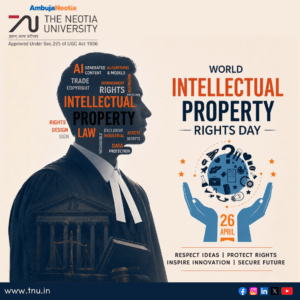
This World Intellectual Property Day, a query that no one can divert their attention from is this:
If AI can create, then who owns the creation?
At the School of Legal Studies, The Neotia University, this, however, is more than just a matter of theoretical debate — it has already become a classroom discussion, a research theme, and a professional need.
The Shift: From Human Creativity to AI-Assisted Innovation
- Intellectual Property Rights (IPR) were built on a simple idea: Protect human creativity.
IPR in Transition: From Human Creativity to Hybrid Innovation
Conventionally, IPR systems have been structured on the basis of human composition and ingenuity. Copyrights, patents, and trademarks are just some of the ways that IPR frameworks have rewarded human intellect.
Nevertheless, in 2026, the majority of innovations will result only from joint efforts of humans and intelligent systems.
Besides, AI is already capable of:
- Generating and drafting legal drafts
- Composing music and art
- Assisting in scientific discoveries
Such a change brings up an important legal issue:
Should human creators alone be the ones protected by the law in this age of machine-assisted innovation?
The Legal Dilemma
Here is where things turn to be tangled:
- Who is the author?
Indian copyright law emphasizes human authorship.
So, what happens to AI-generated works in this case?
- Who is the inventor?
AI is assisting in generating inventions.
However, the patent law still demands a natural person.
- What about data?
AI is based on data.
And data is capable of resulting in:
- Copyright issues
- Ownership conflicts
- Privacy matters
India is still far from having an entirely integrated AI-IP framework.
India’s Moment: Challenge or Opportunity?
The Indian situation is very interesting:
- Robust IPR framework
- Fast AI adoption
- Law gaps
This provides a very rare chance:
- Develop a balanced and innovation-friendly IPR model
- Become a policy thinker leader among emerging economies
A Quick Global Comparison
- The US – Strong enforcement, excluding AI as inventor
- The EU – Attention on ethical AI + regulation
- India – Cautious, evolving, and full of potential
Why Legal Education Must Change [Now, Not Later]
This is a challenge for educational institutions to take the lead.
At TNU’s School of Legal Studies, we are constantly trying to innovate legal education:
- AI-integrated curriculum
- Tech-driven legal research training
- Practical exposure (moot courts, internships, workshops)
- Focus on interdisciplinary learning
Because Tomorrow’s lawyer will not only be someone who interprets law but will also be capable of combining law and technology.
The Bigger Perspective
This is not only about law, but also:
- The future of creativity
- Ownership in the digital age
- Regulatory role in innovation
And most importantly:
Are we equipping the next generation of lawyers to handle such changes?
Final Thought
Nowadays, Intellectual Property is not just about safeguarding. It is about changing the concept of creation.
This World IPR Day, we should think again:
Not just what we protect – but who (or what) creates.
Share:


